Big Agnes Fly Creek Hv Ul 3 3-season Backpacking Tent Review
Big Agnes Fly Creek HV UL2
Price: $370
Packaged weight: 2 lbs. 4 oz. (2P)
Floor surface area: 28 sq. ft.
Capacities: 1P, 2P
What we like: Truly ultralight at a competitive price.
What we don't: One door/antechamber layout limits practicality; not suitable for very inclement weather.
See the Big Agnes Fly Creek HV UL2
In many ways, Big Agnes' Fly Creek helped bring the ultralight movement to the mainstream. At nether 2.v pounds, it's comparable to a bivy sack or hammock and stuffs down impressively small in a pack. Recently retooled with a solution-dyed textile, streamlined pole clip organization, steeper walls, and larger entryway, we put the latest version of the tent to the test in Colorado's San Juans and Washington'due south Cascade mountains. The verdict: while it'south nevertheless a leading UL pattern, the Fly Creek does come up with notable compromises in interior space, storage, and weather protection. Below we break down the Fly Creek'south overall performance. To see how information technology stacks upward to the competition, see our article on the best backpacking tents.
Table of Contents
- Weight and Packed Size
- Livability and Interior Space
- Immovability
- Atmospheric condition Protection
- Ventilation
- Vestibules and Storage
- Set up and Take Down
- Sustainability
- What We Similar/What We Don't
- The Competition
Performance
Weight and Packed Size
Tents are one of the first pieces of gear backpackers look to in social club to cut weight, and the Big Agnes Wing Creek HV UL2 Solution Dye delivers at merely two pounds four ounces all in. In terms of competition, Big Agnes' own Tiger Wall UL2 (2 lbs. 8 oz.), Nemo's Hornet (2 lbs. 6 oz.), and REI'southward Flash Air ii (2 lbs. 8 oz) clock in slightly heavier, although all three characteristic 2-door-and-vestibule layouts that add a neat deal of convenience (the Fly Creek has but one door and vestibule). Nemo'due south Hornet Elite (2 lbs. 1 oz.) is 1 of few ultralight models to undercut the Wing Creek, but the fabrics are concerningly thin, and the tent won't agree upwardly in truly rough conditions (plus, it's much pricier at $500). Zpacks' Duplex (ane lb. 3 oz.) is another popular option amid thru-hikers, but its trekking pole-supported design isn't as convenient, and you pay a steep premium ($649) for the Dyneema fabrics. All in all, the Wing Creek is a solid value for a proven UL design.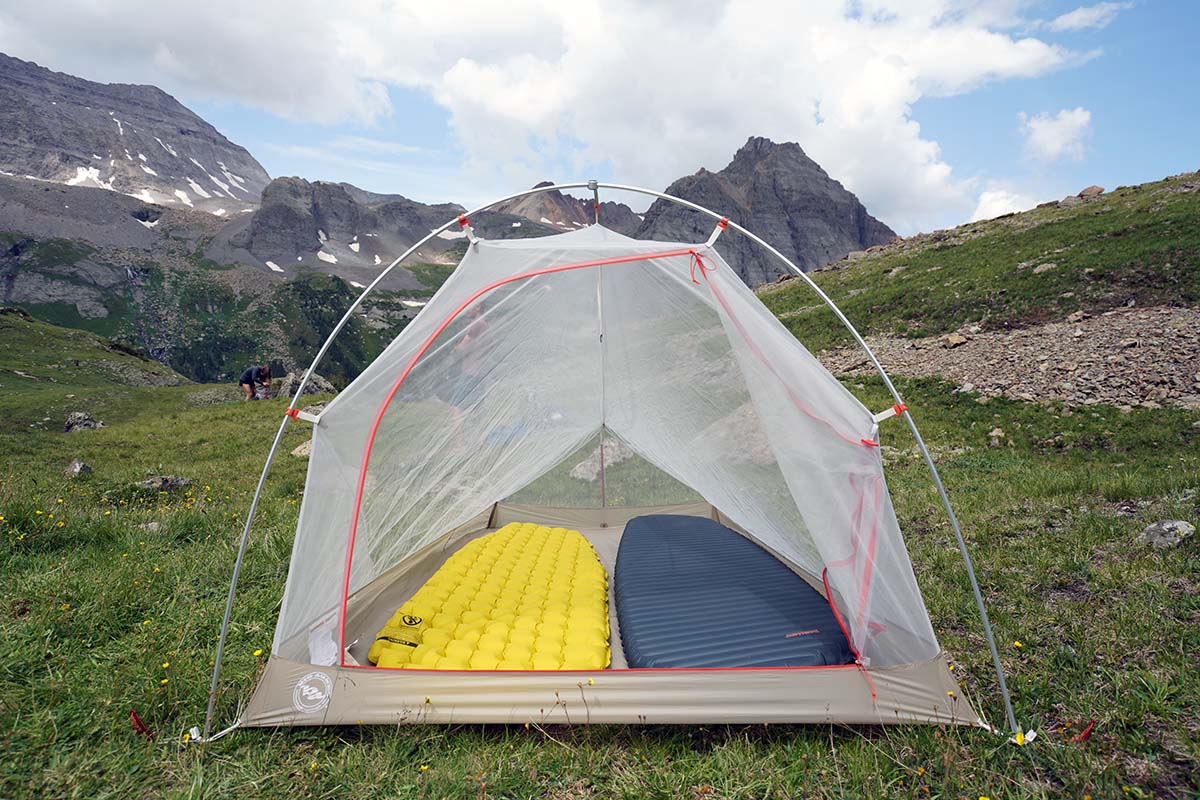
Lining up with its weight, the Fly Creek's simplistic pole structure and thinner materials allow it to pack downward to a relatively tidy shape that stuffs fairly hands into a pack. Nonetheless, it's worth noting that the latest Solution Dye model is larger than its predecessor, with a 6 10 nineteen.v-inch shape that's larger than much of its contest (the previous model measured 4 x nineteen in.). For comparison, it'due south bulkier than almost all of the aforementioned competitors, including the Big Agnes Tiger Wall (5.5 x 18), Nemo Hornet (five.5 ten 19.5), REI Co-op Flash Air (7 ten sixteen), and Nemo Hornet Elite (4.five x 19). But to be fair, the Fly Creek still stuffs down to a pretty diminutive size, and about backpackers should have no issue finding room for it (you can ever split up the pole bag from the rest of the tent to maximize space in your pack).
Livability and Interior Space
Without a incertitude, one of the biggest compromises in choosing the Big Agnes Fly Creek HV UL2 is interior infinite. Put but, the UL2 version is best used as a solo tent. You do go decent head room at 42 inches (two in. more than its predecessor) due to the tilted hubbed pole above the door and steeper walls (hence the "HV," or loftier-volume, in the proper name). However, the tapered shape means it can hardly fit 2 regular-width (20-in.) sleeping pads without some overlap (you'll want a mummy-shaped pad), and the tapering at the foot end makes it nearly incommunicable to slumber head-to-toe with your tentmate. In the end, our take is that the Fly Creek is a solid setup for one (provided you lot slumber in the centre) merely a pinched infinite for 2 adults.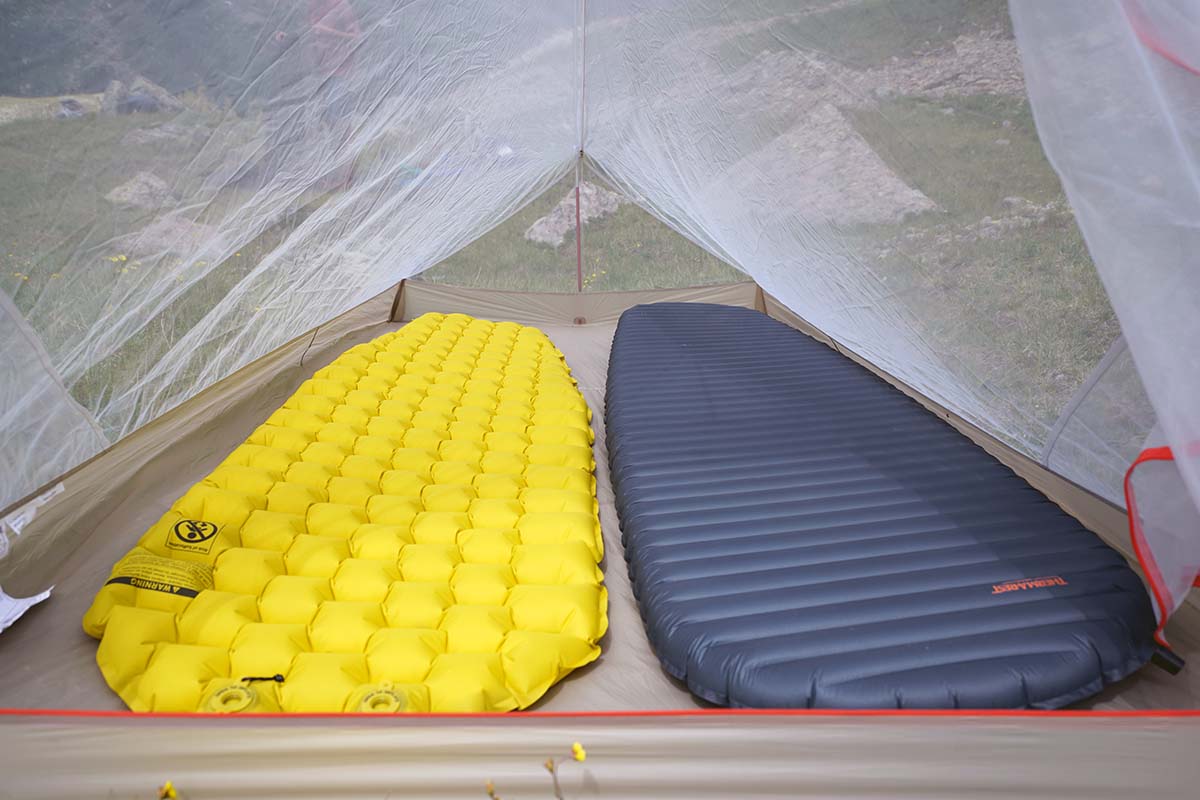
Durability
Similar many ultralight tents, the Fly Creek sacrifices a considerable amount of durability in club to keep weight low. The included DAC Featherlite poles aren't every bit strong as heavier varieties, the 15-denier (D) rainfly is partially transparent, and the 20D floor certainly requires extra care (Big Agnes sells a footprint for $75, or you lot can go the budget route with a standard polypro footing cloth). But despite these compromises, it'due south important to point out that the Fly Creek is pretty average in the UL market, and plenty of tents in the same weight class use even thinner fabrics, including REI's Flash Air with a 15D floor and Nemo's Aristocracy line with 10D floors.
To really put the tent's immovability to the test, I took the Fly Creek into very windy conditions in Washington Country'southward Enchantments. At one signal, a strong gust entered the partially unzipped vestibule, turned the tent into a sail, and snapped a pole in half (which then proceeded to puncture the fly). This likely wouldn't take happened had I kept the anteroom fully closed, simply a sturdier tent certainly would accept held up meliorate in the same weather. Information technology's important to notation that our experience with Large Agnes' customer service was excellent: they facilitated a repair of our pole (turnaround fourth dimension was roughly ii months) and provided instructions on how to patch the pelting fly. From a sustainability standpoint, we actually appreciate that they aim to repair rather than supplant tent parts, which mitigates waste matter and needless shipping fees.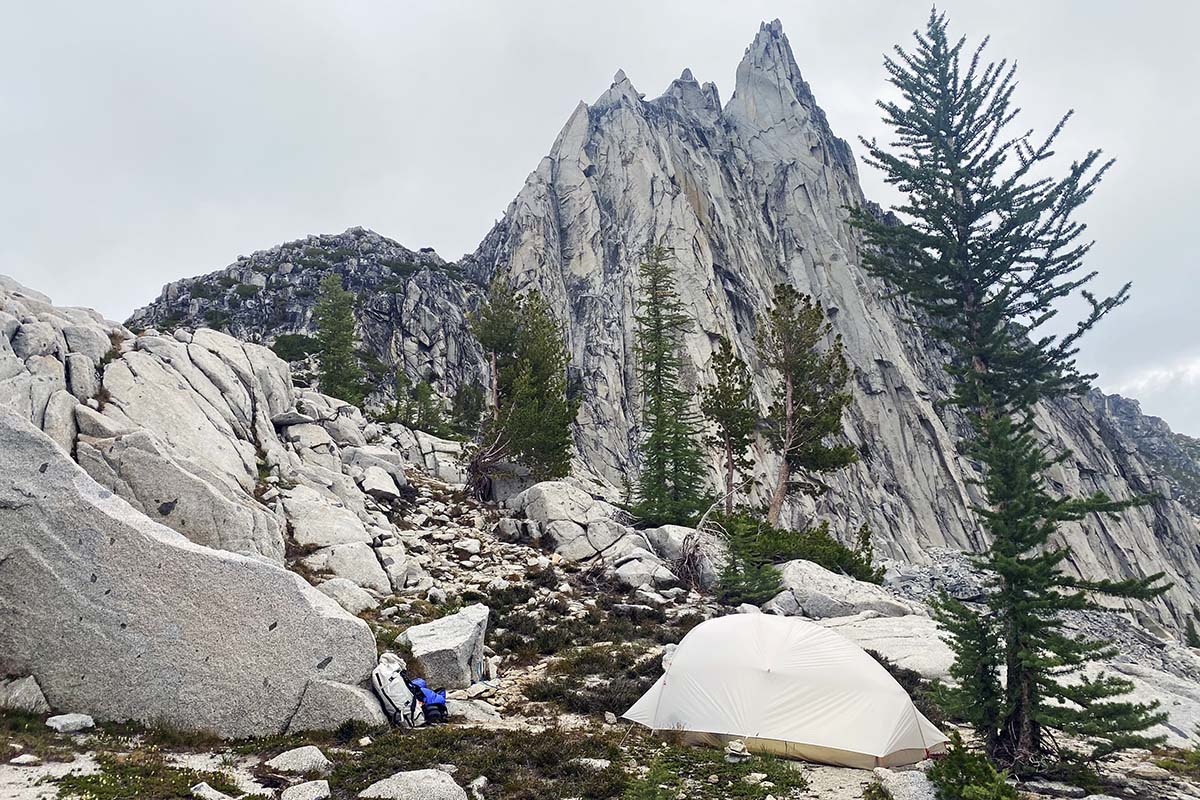
Weather Protection
The Big Agnes Wing Creek HV UL2 is listed as a 3-season backpacking tent, which technically means it should go the job washed in spring, summer, and fall atmospheric condition. That said, after a full summer of testing, I'm hesitant to recommend it for annihilation other than balmy conditions. Get-go and foremost, the Fly Creek struggles in heavy rain. While you lot exercise get a total-coverage rainfly and quality seam sealing (not always the case in the ultralight market), the tent has express structure and support. With just a single pole running downwards the spine, the fly has a trend to press up confronting the sides of the tent, which tin cause water to seep through the mesh canopy walls. To mitigate this, you'll desire to be certain to fully guy out the Fly Creek, including the midpoint sections on the fly.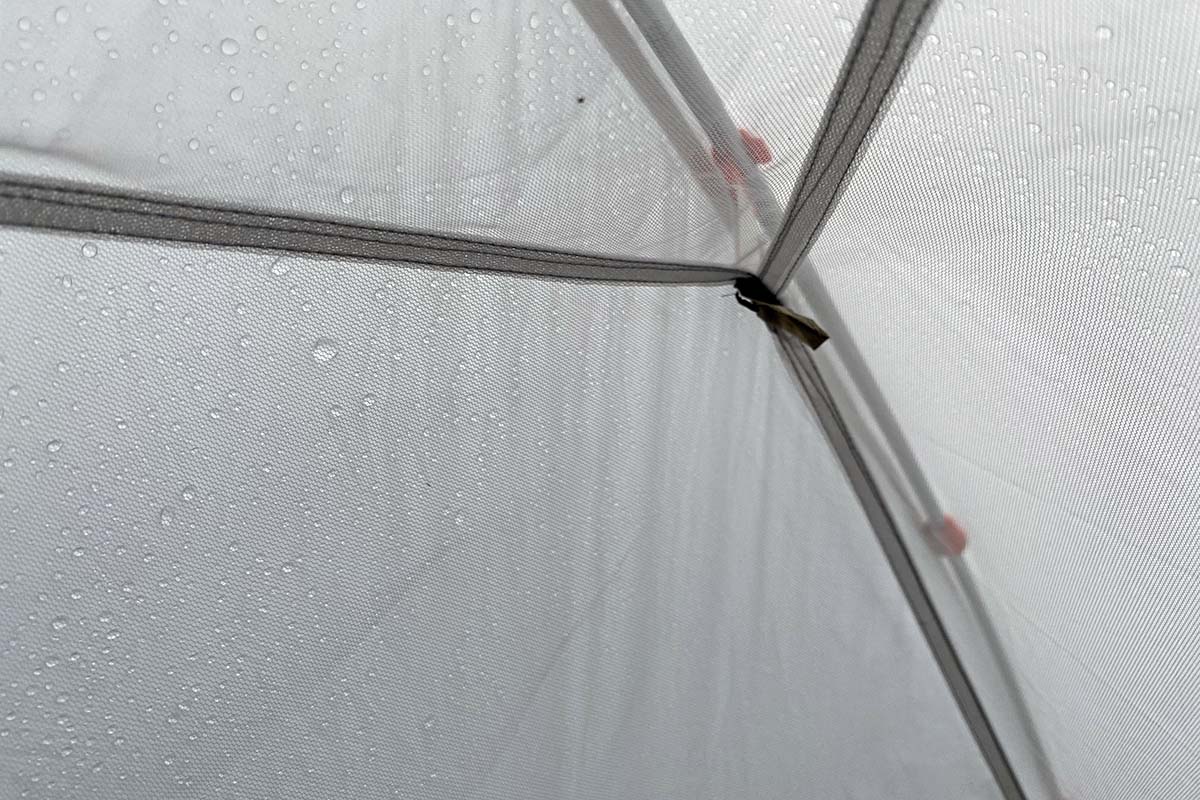
Unfortunately, wind protection is even worse due to the single-pole structure and mesh-heavy build. During our night of stiff winds in the Enchantments, the Fly Creek consistently caved in from both sides, and dirt crept through the gap betwixt the rainfly and torso, piling upwards on our sleeping bags, sleeping pads, and faces. All told, if you anticipate frequenting gusty conditions, I recommend opting for a design with less mesh, taller bathtub floors, and a crisscrossing pole construction similar Large Agnes' own Copper Spur (even the eye ridge pole of the Tiger Wall would add some stability). Unmarried-wall tents tend to be the best performers in this regard with picayune to no mesh, although the tradeoff is considerably less breathability.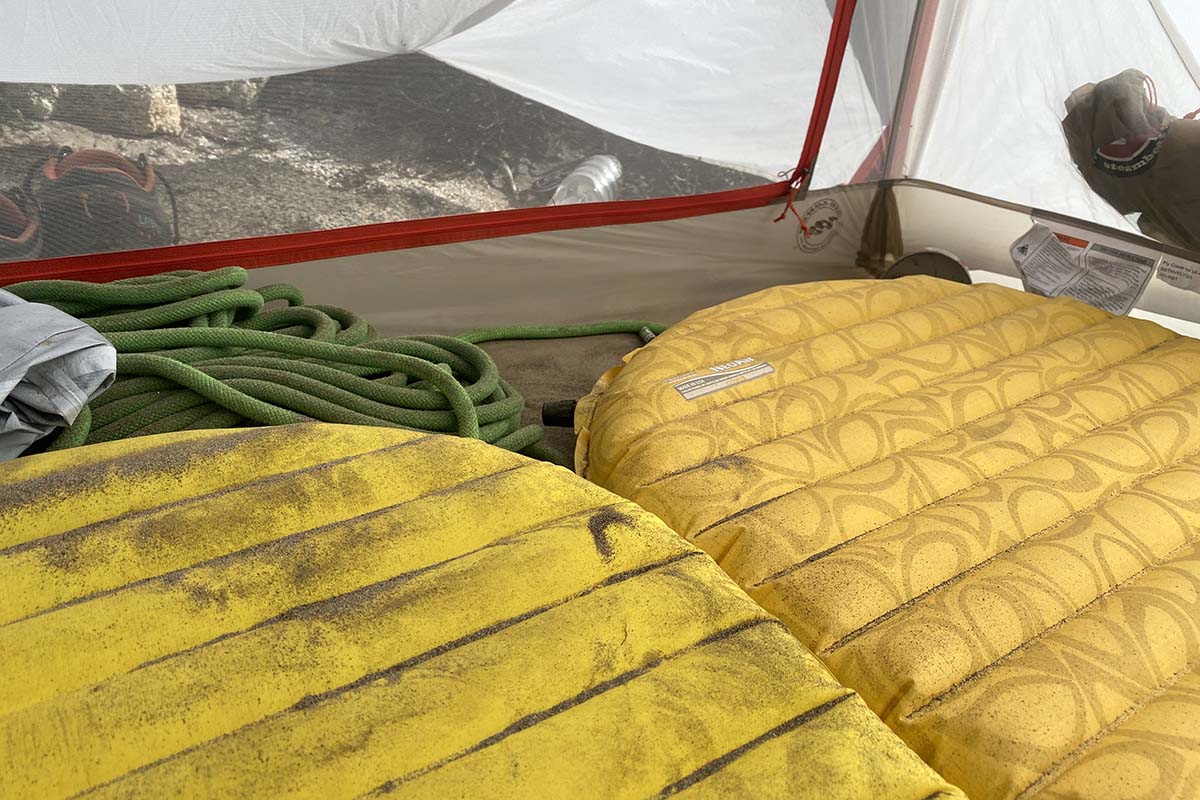
Ventilation
The flipside to the Fly Creek'southward compromised atmospheric condition protection is splendid ventilation. The generous use of mesh and double-wall construction allow air to flow freely betwixt the rainfly and the tent trunk, mitigating moisture buildup. Key to this is getting a taut and fully guyed-out pitch, which prevents the sidewalls from sagging and maintains separation between the fly and canopy. Nosotros would love to see Big Agnes add together a built-in roof vent to further boost airflow, but the Wing Creek even so is a decent overall breather because its ultralight build, and especially when compared with single-wall competitors.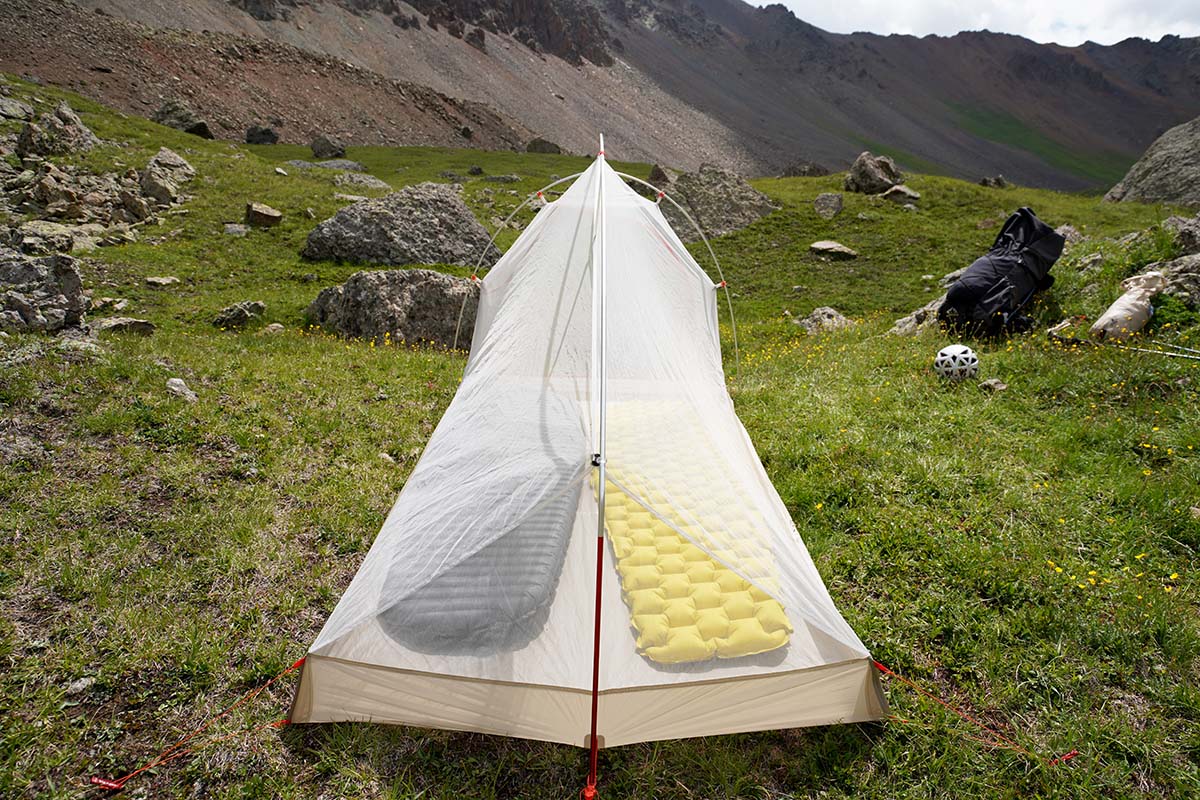
Vestibules and Storage
One major way Big Agnes cut downwards on weight with the Fly Creek HV UL2 was by using a single door and vestibule at the head end of the tent. We prefer this layout to a single side door, which can create challenges getting in and out of the tent when camping ground with a partner. That said, it's however not our favorite setup. Putting your backpacking pack in front end of the door blocks access, and information technology tin can be downright tricky to navigate the various footwear and gear in front end when entering and exiting. Single backpackers might not heed, but even on solo trips, nosotros prefer the convenience of two vestibules and so that nosotros can dedicate one solely to gear. The skilful news is that the entrance hall door opening is very wide (and now taller with the latest update), and rolling information technology dorsum is a nice way to allow in light in off-white weather. Plus, interior storage is decent: there is a triangular pocket by the caput at each side and a larger pocket along the roof, although we found the latter to be prohibitively shallow—it consistently ejected our phone and headlamp onto the bed below.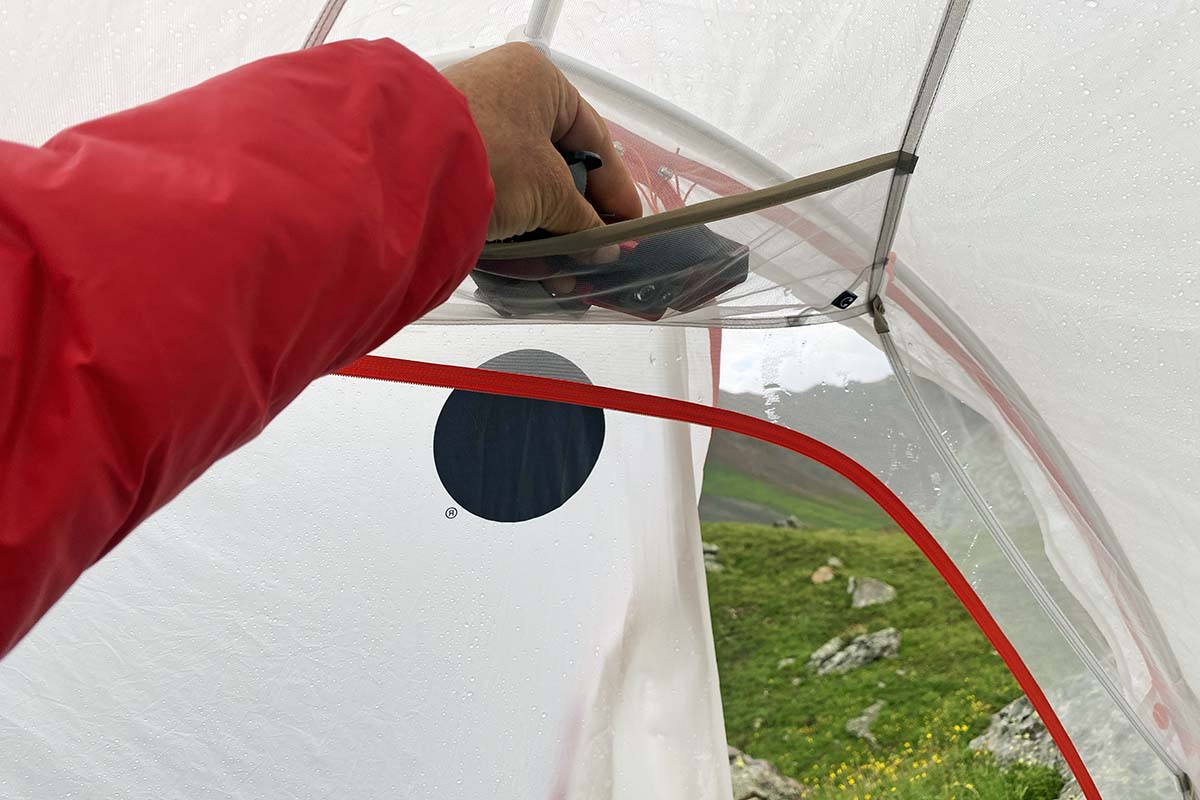
Set up and Have Down
With only one hubbed pole, the Wing Creek's set-upwardly process is adequately unproblematic: simply insert the 3 pole ends into ii grommets at the head and one at the foot. Due to the tent'south semi-freestanding design, it's also important to pale or guy out the ii corners at the foot end. This requires that you pitch your tent on a reliable surface where you can securely drive stakes into the ground or bring extra guylines to secure the corners to rocks or trees. And equally I noted above, you'll also desire to guy out the tent at all other points to maximize ventilation and weather protection. But fifty-fifty with these added steps, the Fly Creek still is simpler and easier to prepare than non-freestanding UL builds like the Zpacks Duplex.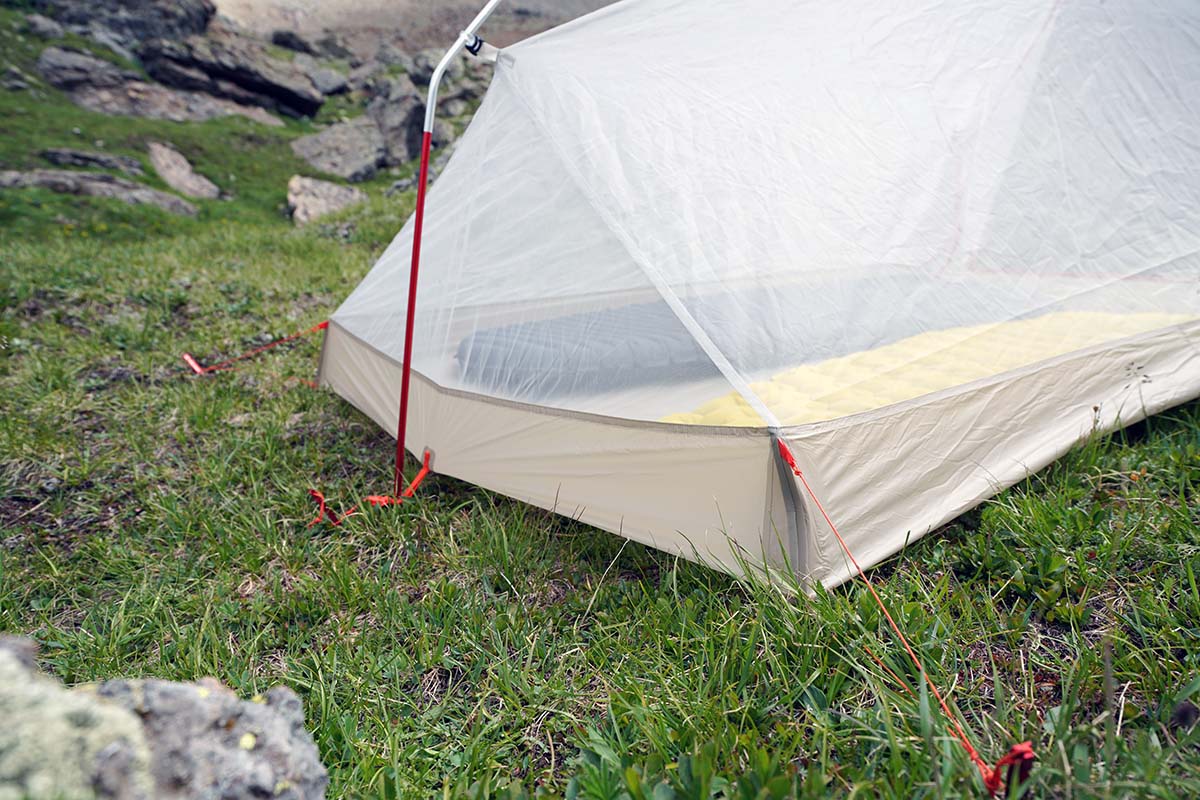
Sustainability
The Fly Creek HV UL2 is now fabricated with solution-dyed material, which uses less water and energy during production and is more than UV-resistant and less prone to fading over time. Further, the DAC poles tin can be recycled at the end of their lifespan and are anodized in a way that minimizes fuel and energy consumption. Finally, Big Agnes is at present office of the Outdoor Industry Association's Climate Activeness Corps, and each of their three U.Southward. facilities operates via 100-percent-renewable electrical energy. While the best thing you can do for the planet is reduce your consumption and use what you already accept, we appreciate Big Agnes' efforts towards more sustainable and environmentally friendly manufacturing.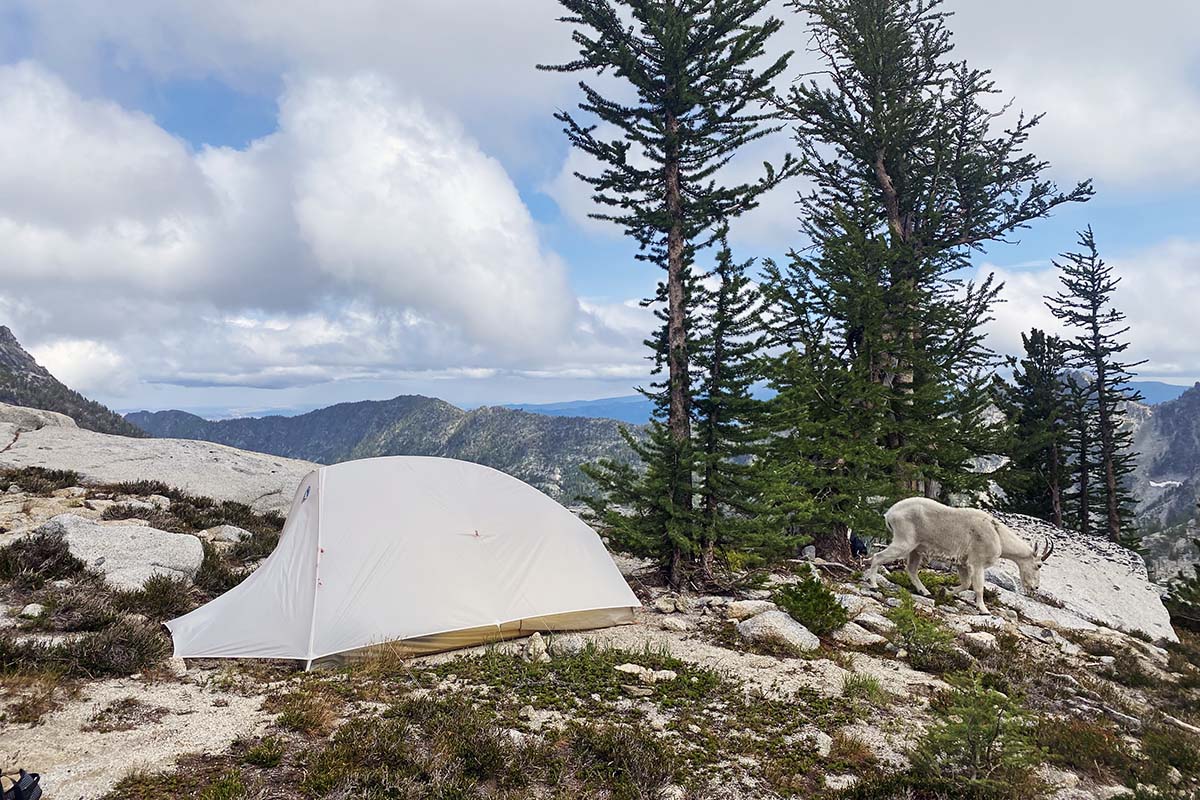
Other Versions of the Large Agnes Wing Creek
We tested the two-person version of the Fly Creek HV UL, and Big Agnes besides makes the tent in a 1-person model. The Fly Creek HV UL1 shares almost of the design features of the 2P tested hither in a trimmed-down shape and lighter-weight bundle (two lbs). However, given the UL2's feathery build, nosotros retrieve the added space is worth it, fifty-fifty for solo backpackers. And rounding out the collection, Big Agnes besides makes ultralight Platinum and Carbon models in one- and two-person capacities. The Platinum uses even thinner nylon fabrics, while the Carbon utilizes Dyneema and carbon fiber poles for a crazy low 1-pound-vii-ounce weight for the 2P (at a whopping $850).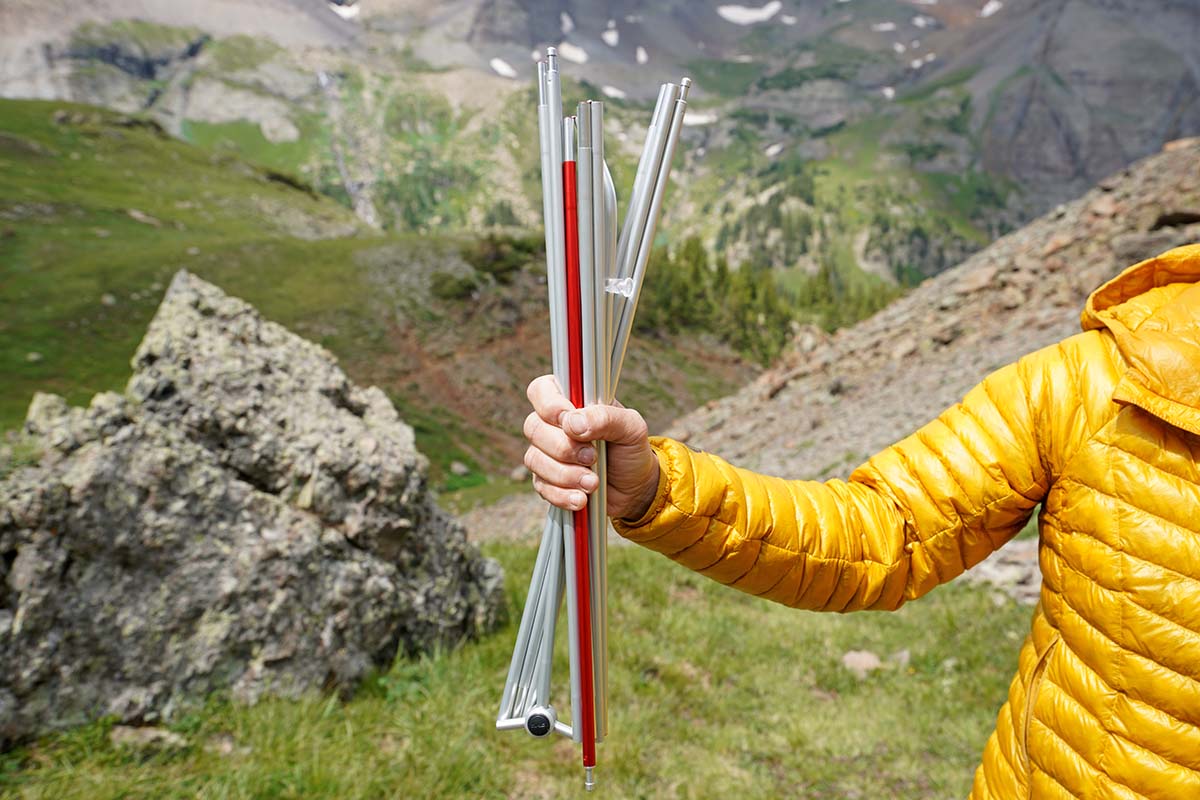
What Nosotros Like
- Proven ultralight pattern at a reasonable price.
- Double-wall build isn't common in the UL world only greatly improves ventilation and minimizes condensation buildup inside the tent.
- Simpler and quicker to set than many non-freestanding ultralight models, including the trekking pole-supported Zpacks Duplex.
- Comes with a full-coverage rainfly and seam sealing.
What We Don't
- Due to the single-pole spine and mesh-heavy design, the Fly Creek does not concur up to high winds or steady rainfall.
- Only has one door and one vestibule, which makes entering and exiting the tent difficult and limits storage space for gear.
- Cramped for two campers. Information technology can hardly fit 2 regular-width (20-in. sleeping pads) without some overlap.
- 15D wing and 20D floor are adequately standard in the lightweight tent market but will crave some added care to forbid tears and snags.
Comparing Tabular array
| Tent | Price | Weight | Expanse | Floor | Height | Door(s) | Capacities |
|---|---|---|---|---|---|---|---|
| Big Agnes Wing Creek HV UL2 | $370 | 2 lbs. 4 oz. | 28 sq. ft. | 20D | 42 in. | 1 | 1P, 2P |
| Nemo Hornet 2P | $370 | 2 lbs. 6 oz. | 27.v sq. ft. | 15D | 39 in. | ii | 1P, 2P |
| Big Agnes Tiger Wall UL2 | $400 | 2 lbs. 8 oz. | 28 sq. ft. | 15D | 39 in. | two | 2P, 3P |
| REI Co-op Wink Air ii | $299 | 2 lbs. 8 oz. | 28.vii sq. ft. | 15D | 42 in. | 2 | 1P, 2P |
| Tarptent Double Rainbow | $319 | 2 lbs. x oz. | 30.6 sq. ft. | 30D | 40 in. | 2 | 1P, 2P |
| Zpacks Duplex | $649 | 1 lb. iii oz. | 28 sq. ft. | 1 oz./sqyd | 48 in. | two | 1P, 2P, 3P |
The Competition
Big Agnes' Wing Creek HV UL2 is a leading ultralight backpacking tent for its feathery build, double-wall construction, and competitive price. Its closest competitor in the UL category is Nemo's Hornet 2P. The tents are nearly identical in weight (the Fly Creek wins out by 2 oz.), immovability (the Nemo uses 10 and 15D fabrics while the Big Agnes uses 15 and 20D), build quality, and similarly tight quarters inside. Further, both excel for solo backpackers despite their two-person designations. That said, the Hornet is the more convenient option thanks to its two door/entrance hall layout, which makes it feel less claustrophobic overall. All in all, given the similarity in weight and identical cost, we give the border to the Hornet for its less compromised build.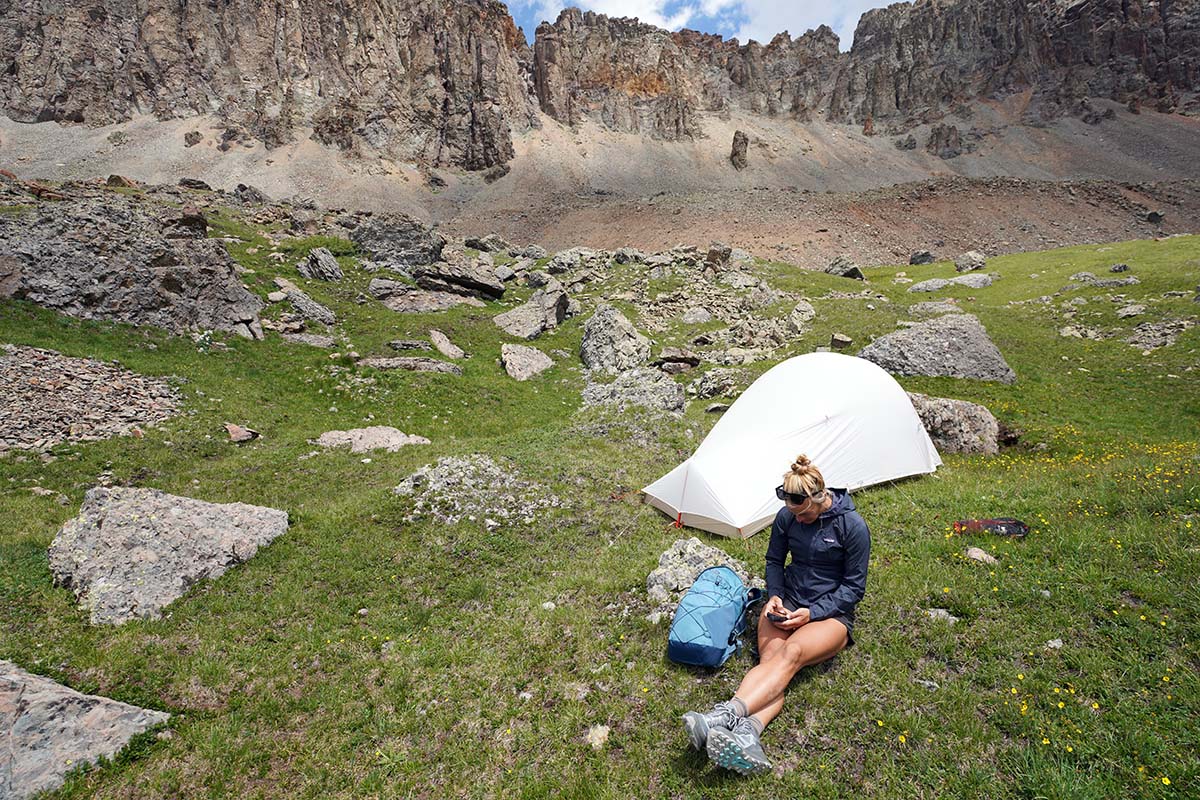
Large Agnes' ain Tiger Wall is an interesting culling to consider, combining pattern elements of the Fly Creek and the more characteristic-rich and spacious Copper Spur. Like the Wing Creek, the Tiger Wall UL2 at present uses a solution-dyed fabric and is semi-freestanding merely adds a center ridge pole and two door/vestibule layout that profoundly improves livability and stability in loftier winds. The Tiger Wall is nevertheless fairly snug inside despite these additions (it has the same square footage), although it can adjust two backpackers much more easily than the Fly Creek. All in all, the Tiger Wall strikes united states of america every bit the better-balanced build, and especially given that it just weighs an boosted 4 ounces.
REI Co-op jumped into the UL tent world with their Flash Air, which features a unique, non-freestanding build that uses ii side poles (swapping them for trekking poles saves another 3.4 oz.) to create its construction. The Fly Creek beats information technology in weight by 4 ounces and is a bit faster to set up with its semi-freestanding design, but the Flash Air 2 nonetheless is reasonably quick and very user-friendly, plus it'due south slightly roomier inside with 28.vii square feet of floor area (compared to the Fly Creek's 28 sq. ft.). All in all, the Flash Air is the much improve choice for two backpackers, and we think even single backpackers will appreciate the REI's two door/vestibule layout and larger interior dimensions (not to mention, y'all save around $70 with the Flash Air).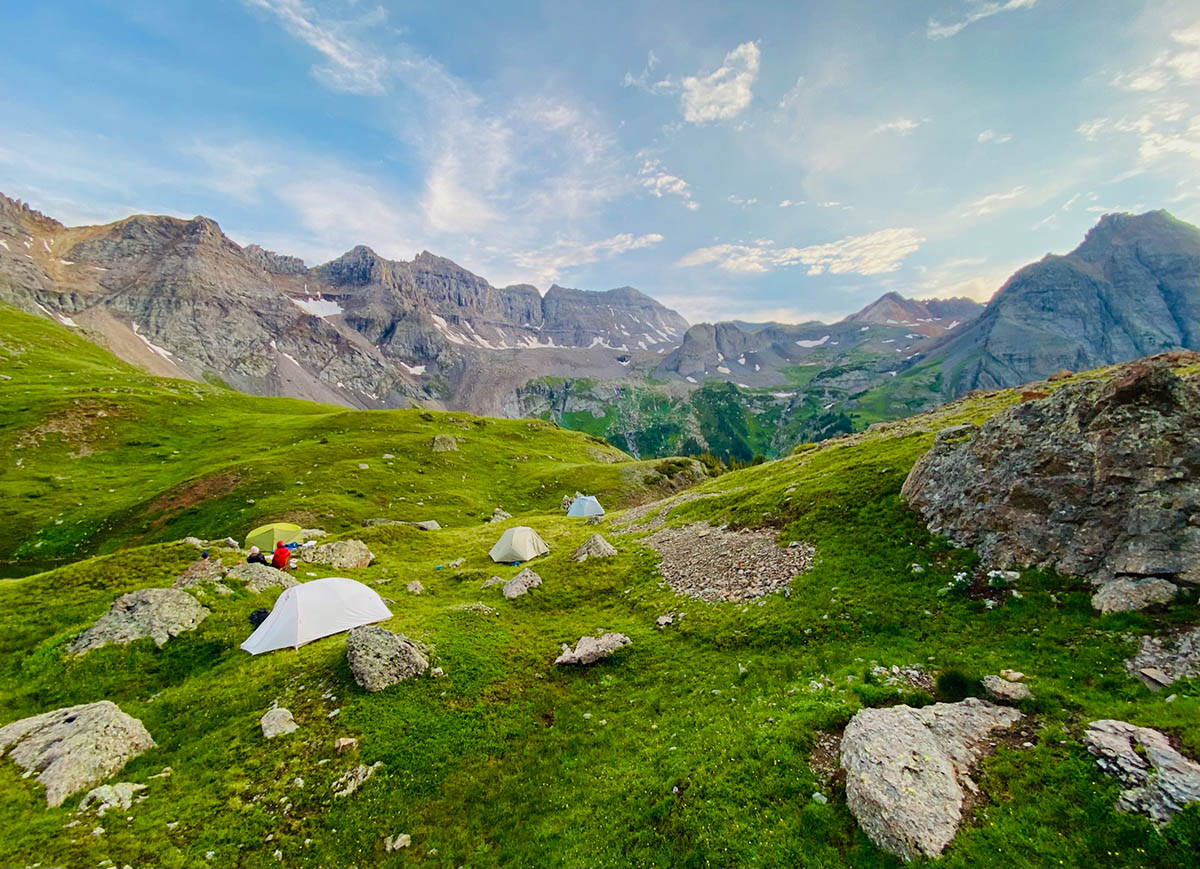
Moving into the cottage tent industry, the Tarptent Double Rainbow is some other quality UL design to consider. Stacked upward to the Fly Creek, the Tarptent is more than affordable at $319 but weighs considerably more than at 2 pounds x ounces all in (including poles, stakes, and the stuff sack) and uses a non-freestanding structure. The Tarptent's hybrid single-wall build also makes it more decumbent to moisture buildup, and the Double Rainbow doesn't come with sealed seams (yous can pay for this service from Tarptent for an boosted $35). In the terminate, the Double Rainbow is cheaper, more than durable, and improve in air current than the Fly Creek, but the Large Agnes wins out in most every other category.
A final competitor is 1 of the few to beat the Fly Creek in weight: the Zpacks Duplex. The trekking pole-supported design weighs in at just 1 pound three ounces (not including stakes) and is popular among the thru-hiking crowd. However, its single-wall build means it suffers more with condensation than the Fly Creek, and the fully Dyneema structure comes at a steep price ($649 for merely the tent, plus the toll of stakes, trekking or tent poles, etc.). Given the design, the Duplex also takes more effort and time to get a good pitch compared with the more convenient Wing Creek, although it'due south more spacious within while easily winning out in weight. All things considered, the Zpacks isn't for everyone, simply its weight-to-space ratio is hard to beat.
schreiberbropper1975.blogspot.com
Source: https://www.switchbacktravel.com/reviews/big-agnes-fly-creek-hv-ul2-solution-dye
0 Response to "Big Agnes Fly Creek Hv Ul 3 3-season Backpacking Tent Review"
Post a Comment